
WMC “opens a window” for a patient with sequelae of spinal cord injury, delivering positive and effective rehabilitation outcomes!
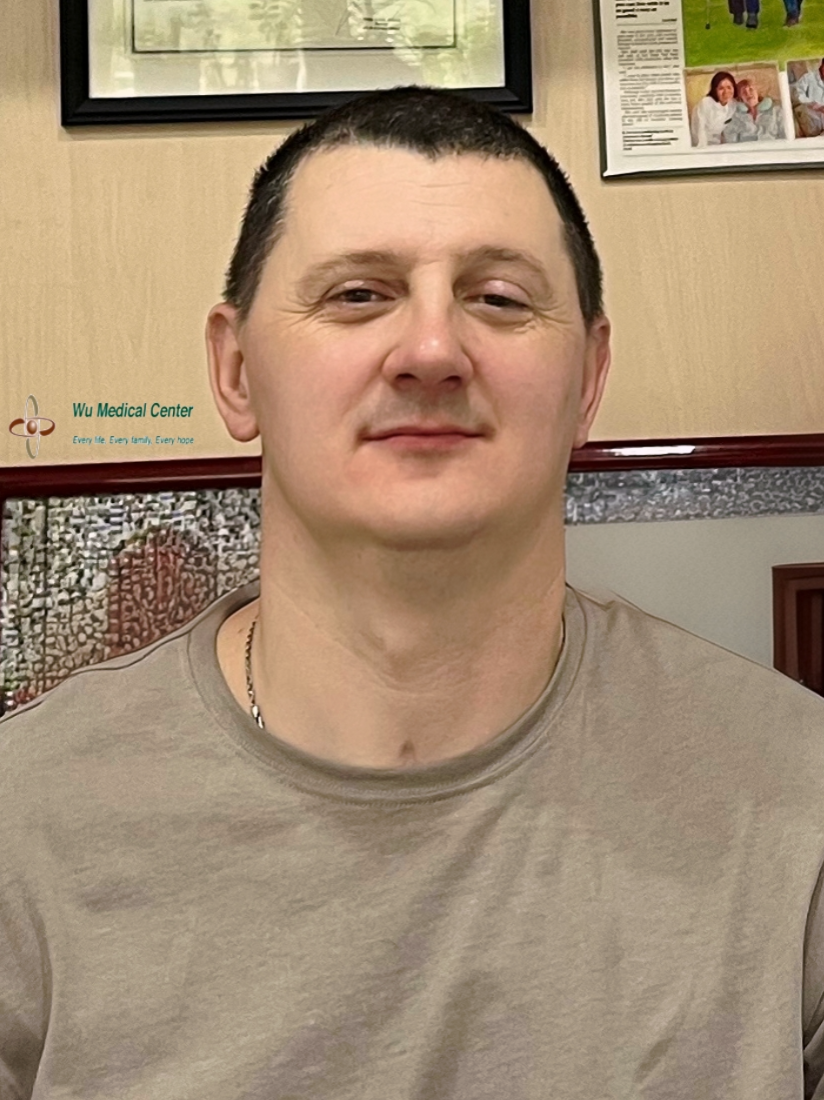 Mr. Ihar Kalcheuski, a tall, handsome and intelligent 41-year-old gentleman from Belarus, unfortunately suffered cervical trauma in an accident four years ago, resulting in sequelae of spinal cord injury. Since then, intractable and refractory ailments caused by limb motor dysfunction and generalized sensory disturbances have plagued him. The robust, energetic body he once possessed was afflicted, and his naturally positive and optimistic temperament faced constant challenges. All of these became obstacles standing in the way of his pursuit of a better life and lofty ideals.
Four years have passed since the accident. Although Mr. Ihar Kalcheuski has actively undergone rehabilitation training under conventional medicine, the normal signal pathways in the spinal cord have been “blocked” due to spinal cord injury. No matter how hard he strived, he could not move his lower limbs and feet at all. In addition, edema in the calves and dorsum of the feet grew increasingly severe. He presented with hyperactive tendon reflexes in both lower limbs accompanied by mild associated reactions, and clonus of the lower limbs could be easily elicited during passive movement. Faced with such physical suffering, Mr. Ihar Kalcheuski and his family had to pause and reflect: what path should they take next? Continue local rehabilitation training with minimal effects? Or consider stem cell therapy like other patients living with sequelae of spinal cord injury? Which medical center should they choose for stem cell treatment? What kind of improvements and outcomes could be expected?
When God “closes a door” for patients living with sequelae of spinal cord injury caused by accidents, He leads them to Wu Medical Center…
Long before devoting himself to the clinical field of stem cell therapy, Dr. Wu was an accomplished neurology specialist. He possesses thorough, exhaustive knowledge of sequelae of spinal cord injury: from textbook theories to clinical manifestations observed in ward patients; from conventional therapeutic approaches to clinical outcomes of patients under his care; and from symptoms immediately following traumatic accidents to long-term manifestations years after patients return to daily life.
It was only after Dr. Wu wholeheartedly committed himself to deeply researching clinical stem cell therapy for patients with sequelae of spinal cord injury that he felt a sense of relief. Drawing upon more than 40 years of neurological expertise, his original, exclusive dual stem cell + CAST therapy developed over 30 years, together with accumulated safe, effective and extensive successful clinical experience, he has “opened a window” for patients with spinal cord injury sequelae. The treatment helps re-establish connections at damaged spinal cord lesions filled with granulation tissue. Combined with comprehensive conditioning, it has substantially assisted numerous patients in alleviating symptoms, making their daily rehabilitation training far more effective, and empowering them to confidently return to daily life and work.
At last, Mr. Ihar Kalcheuski received the stem cell treatment at Wu Medical Center that brought miraculous improvements to his symptoms!
After merely two weeks of inpatient treatment, Mr. Ihar Kalcheuski achieved improved motor function, with all indicators rising by an average of more than 30%.
Before treatment: Lumbar and back muscle strength was Grade 1.
After treatment: Lumbar and back muscle strength improved to Grade 2.
Before treatment: Muscle strength of both lower limbs and feet was Grade 0.
After treatment: Muscle strength of both lower limbs and feet reached Grade 1+. He acquired preliminary ability of two-point support; muscle contraction and slight movement can be observed with exertion, and knee lifting off the bed can be triggered by stimulation.
Before treatment: Clonus existed in both lower limbs and was easily induced during passive leg movement.
After treatment: Clonus of both lower limbs was markedly alleviated.
Before treatment: Mild associated reactions were present in the lower limbs.
After treatment: Limb associated reactions were significantly reduced.
Before treatment: Severe edema appeared on the calves and dorsum of both feet.
After treatment: Edema of both lower limbs basically resolved.
Before treatment: Only upper abdominal reflexes could be elicited bilaterally; middle and lower abdominal reflexes were absent. Hypoesthesia of superficial and deep sensation existed bilaterally below the T7–T8 spinal segment.
After treatment: Upper, middle and lower abdominal reflexes can all be triggered bilaterally. The sensory impairment boundary ascended to the T10 segment. Pain sensation score reached 8–9 points at T10, and 6–7 points at T11–T12. The sensitivity of superficial and deep sensation improved compared with baseline.
Mr. Ihar Kalcheuski experienced the recovery of whole-body motor function as well as superficial and deep sensory function brought by Dr. Wu’s exclusive dual stem cell + CAST therapy. The disappearance of lower limb clonus, associated reactions and lower limb edema filled him and his family with joy.
We will continue to follow up on Mr. Ihar Kalcheuski’s subsequent treatment and rehabilitation training. We believe he will recover faster and better.
We hope to accompany more patients with sequelae of spinal cord injury like Mr. Ihar Kalcheuski to receive the sophisticated dual stem cell + CAST therapy available at WMC. Distinct from conventional treatment, this innovative therapy relieves symptoms, restores motor and sensory functions, enhances quality of life, and allows patients to confidently return to their daily life and work.
To learn more information of Mr. Ihar Kalcheuski’s patient story, please refer to the following link:
Ihar Kalcheuski-Sequelae of Spinal Cord Injury-(Belarus)


